
Audits & Assurance Services
Unparalleled Trust and Insight
HRSS audits and assurance services increase confidence, quality, and accuracy.
At HRSS, we employ a risk-based approach to assurance that is customized to each client’s particular industry, sector, and operations. We develop a deep understanding of each business by examining accounting practices, internal controls, and financial policies. We then identify risks to tailor our audits.
Houston businesses rely on us because we offer hands-on partner involvement, year-round communication, and proactive updates on changing accounting standards and regulations. With HRSS, you meet reporting requirements and gain clearer insights that help you run your business better.
Our Audit and Assurance Services Include:
- Audit, Review, and Compilation of Financial Statements
- Agreed-Upon Procedures (AUP)
- Single Audits and HUD Services
- Title IV Audits
- International Financial Reporting Standards (IFRS) Reporting
Why Choose HRSS for Audit & Assurance?
Clients trust HRSS because we take the time to understand their goals, challenges, and operations. Beyond delivering an independent financial opinion, we also share practical recommendations that support stronger processes and long-term performance.

Aamir Maniar, CPA, CICA
Partner, Assurance Services
Phone: (713) 328-4188
Email: aamir.maniar@hrss.cpa
Take the steps to Mitigate Risk that threaten your business.
Audit of Financial Statements
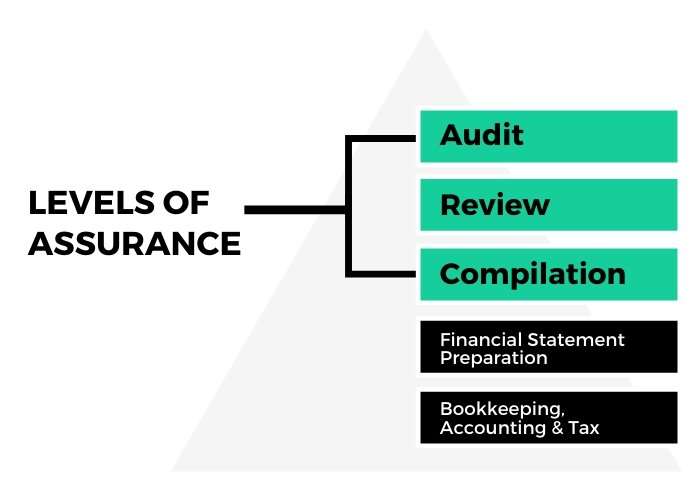
A financial audit offers the highest level of assurance that your statements are accurate and follow GAAP or other required accounting standards. Audits help give stockholders, lenders, and regulators a transparent view of your company’s performance.
With HRSS, you receive more than an audit. You gain a deeper understanding of your company’s financial health and opportunities to improve operations and increase efficiency.
Review of Financial Statements
If you don’t need a full audit, a review of financial statements may be enough. A review provides limited assurance using analytical procedures and management inquiries. Our industry experience allows us to quickly identify trends, irregularities, and opportunities to improve operations.
Compilation of Financial Statements
Compilations are the lowest level of assurance services. Although it does not offer the assurance of an audit or review, a compilation improves the quality of reporting because it helps you present data in accordance with GAAP or other accounting frameworks.HRSS works with your management team to prepare well-organized financial statements that support better decisions and a more stable financial future.
Agreed-Upon Procedures (AUP)
Limited Risk Engagements That Are More Flexible and Cost-Effective
Understand that a full audit is not always required, but there is value in testing your company’s inventory, financials, accounts, operations, policies, and other data.
An agreed-upon procedures (AUP) engagement uses procedures similar to an audit, but on a smaller scale. Different from an audit, no formal opinion will be provided on whether the company’s financial statements have been prepared in accordance with U.S. Generally Accepted Accounting Principles (GAAP), but our clients receive a detailed report on the procedures and an analysis of our findings used to identify specific problems that require immediate action.
AUPs boast several advantages over audits. An AUP engagement allows our clients the ability to choose only the procedures they feel are necessary, which offers them greater flexibility than a traditional audit and is more cost-effective.
An AUP can be useful in situations, such as:
- Suspect fraud or inaccurate reporting
- Need bank or investor verification
- M&A due diligence
- Supply chain or receivable efficiency checks
- Cash balance verification
- IT security and infrastructure confirmation
- Compliance with safety or healthcare regulations
- Require income tax provisions
Contact our audit team for more information.
SINGLE AUDITS & HUD SERVICES
Determine If You Are Subject to Single Audit Requirements
If your organization receives federal funds, you may be required to undergo a Single Audit. Any non-federal entity that receives federal awards exceeding $750,000 during its fiscal year is required to have a Single Audit (or Uniform Guidance Audit) performed in accordance with the Single Audit Act, Universal Guidance, and OMB circular requirements. We are committed to providing the most cost-effective compliance audit. We also analyze the efficiency of your controls, and we provide an opinion on whether your organization has complied with the requirements applicable to your grants.
Nonprofits, school districts, arts organizations, housing programs, municipalities, and for-profit entities working with HUD rely on our team to stay compliant and avoid costly issues.
If you’re unsure whether your organization requires a Single Audit or are unsure of which programs qualify, we can guide you through every step.
Title IV Audits
Helping Schools Stay Compliant and Eligible
The rules around Federal Student Aid programs change often, making compliance challenging for colleges, universities, and vocational schools. HRSS helps educational institutions navigate these requirements so they can stay eligible for Title IV funding.
Our Title IV Services Include:
- Gathering and organizing required audit documentation
- Reviewing controls and data for accurate reporting
- Performing GAGAS-compliant financial statement audits
- Conducting Student Financial Aid compliance audits
- Providing recommendations to strengthen performance and maintain compliance
Our Title IV audit professionals will help you maintain compliance with the U. S. Department of Education, Student Financial Aid, and other governmental regulatory requirements. Contact us for more information.
IFRS Reporting
Preparing for a Global Standard
Throughout the world, companies use two predominant accounting standards to report their financial results: GAAP and IFRS. Most of the countries in the world have adopted IFRS, developed by the International Accounting Standards Board (IASB). IFRS is becoming the global accounting standard for the preparation of public company financial statements. At HRSS, we help Houston businesses understand and transition toward IFRS with ease.
Our audit professionals have extensive experience with audits of IFRS financial statements and keep abreast of the changes in IFRS and efforts to converge U.S. and international accounting standards. Convergence raises a number of issues for companies, including external financial reporting, business strategies and policies, processes, financial reporting systems, underlying data, internal reporting, and more. HRSS can help your company succeed and assess the impact of IFRS on your company and key reporting areas by using a pre-adoption assessment to identify and prioritize issues that require attention.
We can provide IFRS accounting support to make sense of the statements and captions affected by the conversion to IFRS. In our work assisting clients with their internal controls, we can assist management in managing change, assist with accounting systems and internal controls design and implementation, assist with the selection of IFRS accounting policy alternatives, and help assess the implications. Our trained professionals can also examine operational impacts on compensation plans, loan covenants, and dividend policies, as well as handle communication with stakeholders on any changes and developments.
Our IFRS Services Include:
- Audits of IFRS financial statements
- Component audit procedures for foreign-owned subsidiaries
- IFRS impact assessments
- IFRS adoption planning and support
- Policy selection and conversion assistance
- Preparing IFRS-compliant statements and disclosures
- Training for accounting personnel
Key Differences Between GAAP and IFRS:
- GAAP is prescriptive and rules-based; IFRS is subjective and principles-based
- IFRS does not allow Last-In, First-Out (LIFO)
- IFRS allows asset revaluation in certain cases
- IFRS requires more detailed footnote disclosures
- IFRS uses a single-step impairment test; GAAP uses a two-step method
If you’re considering IFRS adoption or need help navigating the principle-based standards, HRSS is here to support you.